The Autumn Budget has arrived, and as usual, there is a lot to take in.
But if you run a business, the useful question is not:
“What was announced?”
It is:
“What actually changes for me, and what should I review now?”
 The Budget, delivered on 28 October 2026 by Chancellor of the Exchequer John Healey, did not increase the headline rates of Income Tax, National Insurance or VAT. Corporation Tax also remains at 25%, with the small profits rate remaining at 19%.
But beneath those headline numbers are several changes that could affect your payroll costs, investment decisions, exit plans, business rates, online sales and financial systems.
Here are the areas we think business owners should have on their radar.
1. If you employ people, review your payroll costs for April
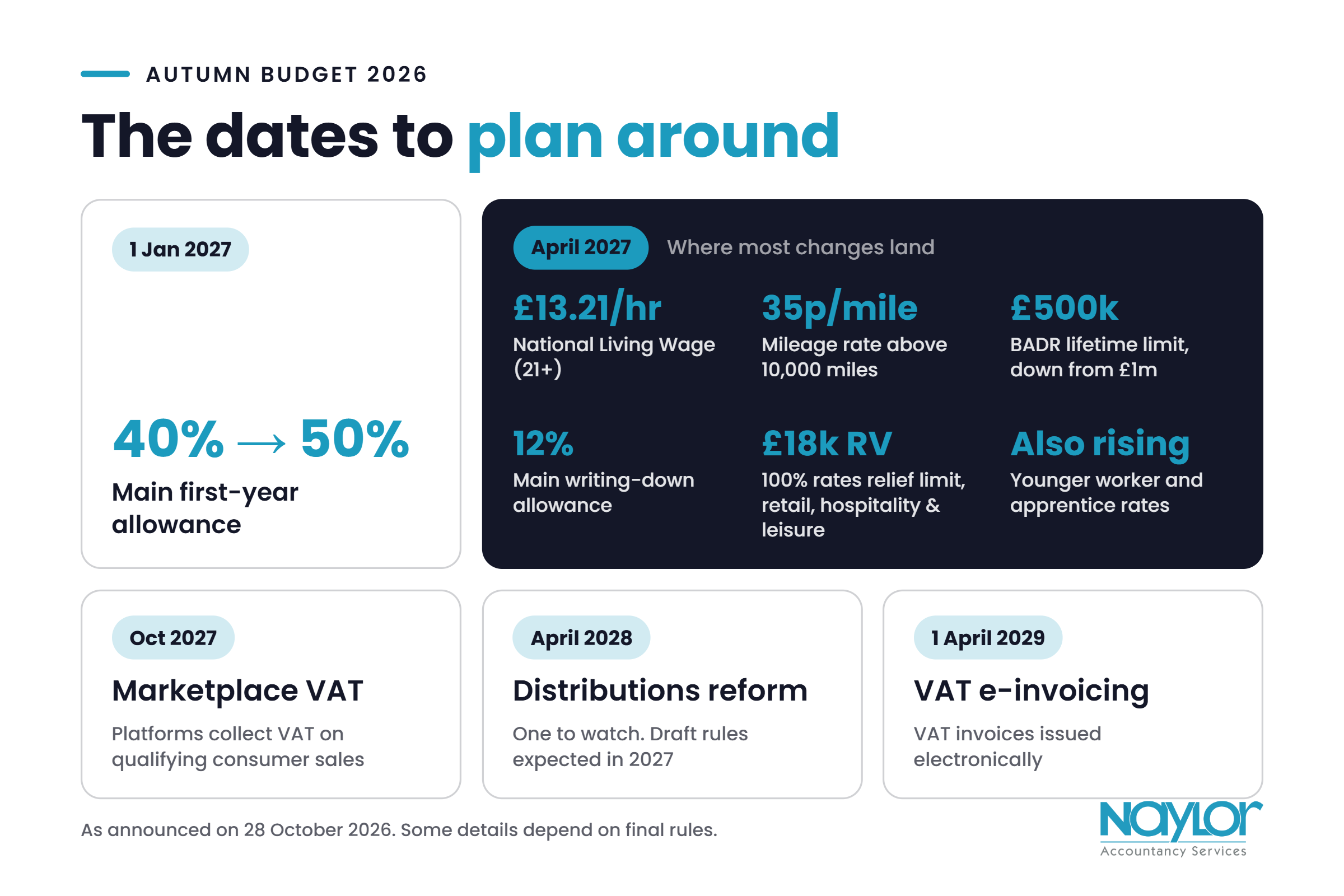
From 1 April 2027, the National Living Wage for workers aged 21 and over will rise from £12.71 to £13.21 an hour.
The rates for younger workers and apprentices are also increasing.
For businesses with several employees at or around minimum wage, the practical impact is not simply the extra hourly rate. You need to consider what the change does to your wider payroll budget, margins, pricing and cashflow.
For a service business, where salaries can be one of your largest costs, even a seemingly modest increase can affect the real cost of delivering your work.
Now is the time to build those changes into your forecasts rather than discovering the impact after April.
2. If you use your own car or van for business, mileage rates are changing
The Budget has also confirmed changes to the approved mileage rates for people who use their own car or van for business journeys.
The rate for the first 10,000 business miles increased from 45p to 55p per mile from 6 April 2026, and the Budget has now confirmed that increase permanently.
For business mileage above 10,000 miles, the rate will increase from 25p to 35p per mile from 6 April 2027.
If you or your employees regularly use personal vehicles for business journeys, it is worth making sure your mileage policies, expense processes and financial planning reflect the correct rates.
It is also a useful reminder to keep clear records of genuine business mileage, rather than relying on estimates at the end of the year.
3. If selling the business is part of your plan, revisit BADR
Business Asset Disposal Relief, or BADR, can reduce the Capital Gains Tax payable on qualifying business disposals.
From 6 April 2027, the lifetime amount of gains that can qualify for BADR will reduce from £1 million to £500,000.
That does not mean every business owner planning an exit needs to rush into a decision before April.
It does mean that if succession, retirement or selling all or part of your business is already on your horizon, the numbers and timing deserve a proper review.
A tax change should not dictate your entire exit strategy, but it should form part of it. 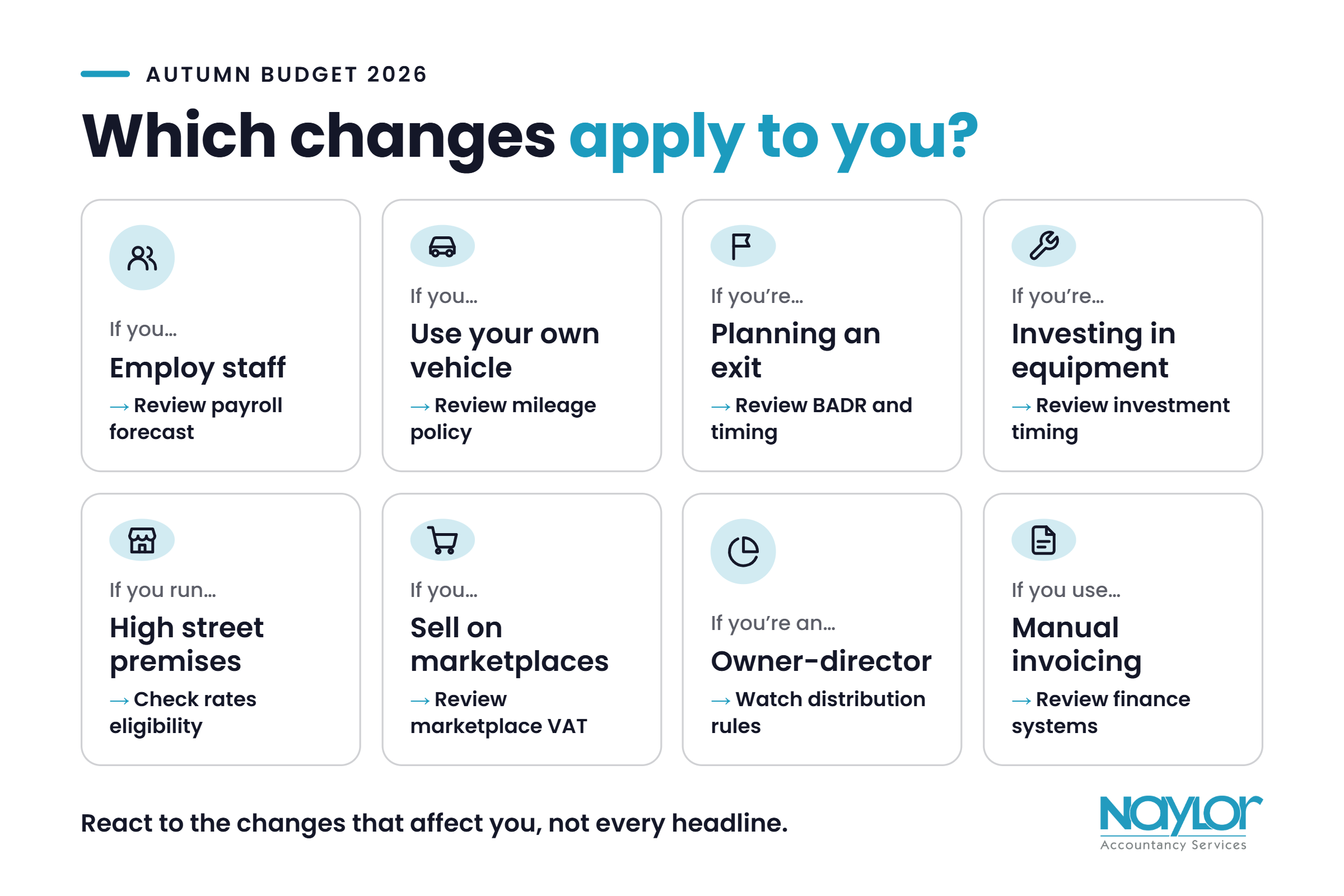
4. Planning to invest in equipment? Capital allowances are changing
The government is keeping full expensing for qualifying company investment, but other capital allowance rates are changing.
The main first-year allowance will increase from 40% to 50% for qualifying expenditure incurred from 1 January 2027.
The main writing-down allowance will then reduce from 14% to 12%, from April 2027.
If significant investment in equipment or other qualifying assets is already in your plans, this is worth discussing before deciding when and how that investment should happen.
The important point is not simply to chase a tax allowance. The investment still needs to make commercial sense for your business.
5. Some high street businesses could see business rates support
For qualifying retail, hospitality and leisure properties in England, the Small Business Rates Relief thresholds will increase from April 2027.
Qualifying properties with a rateable value up to £18,000 will be eligible for 100% relief, with tapered relief available up to £21,000.
There will also be a two-year real-terms freeze on bills for qualifying retail, hospitality and leisure properties.
If you operate premises in one of these sectors, check your rateable value and eligibility rather than assuming the change will automatically apply in the same way to every property.
6. Selling products through online marketplaces? Pay attention to the VAT changes
This is particularly important for product-based and e-commerce businesses.
From October 2027, online marketplaces will become responsible for collecting VAT on qualifying consumer sales made through their platforms by UK VAT-registered businesses. The rules will also extend to certain other UK businesses making more than £90,000 of annual sales in an individual marketplace.
Exclusions include personal sales, second-hand goods, and business-to-business transactions.
If a meaningful part of your revenue comes through online marketplaces, this deserves attention well before October 2027.
For product-based businesses, the effect needs to be understood alongside product cost, platform fees, fulfilment, returns, margins and cash timing. Sales volume on its own does not tell you what the channel is really contributing.
7. Company distributions are changing, but not yet
The government is also reforming the rules covering distributions from companies to individual shareholders.
This area covers more than ordinary dividends. It can include other ways shareholders take value from a company, such as certain share buybacks and capital transactions.
The changes are planned for April 2028, with draft legislation expected for technical consultation in 2027.
For now, this is one to watch rather than something to react to based purely on Budget headlines.
If you are an owner-director, particularly if restructuring, succession or extracting value from your company is part of your longer-term plan, it will be important to review the final rules once the detail is available.
8. Digital tax administration is moving again
The direction of travel towards more digital tax administration is also continuing.
From 1 April 2029, VAT invoices will need to be issued electronically in the required structured format, subject to the detailed rules and exemptions still being developed.
That date may sound distant.
But businesses relying on older invoicing processes, disconnected software or manual work should not ignore it until 2029.
Good financial systems are not only about compliance. They should also give you clearer information, reduce unnecessary admin and help you understand what is happening in the business sooner.
What should you do now?
You do not need to react to every Budget announcement.
You do need to identify the ones that affect your business.
That might mean:
- rebuilding your payroll forecast for April 2027
reviewing an existing exit or succession plan - checking the timing of planned capital investment
- reviewing business rates eligibility
- understanding how marketplace VAT could affect your e-commerce channel
- keeping future shareholder-distribution changes on your planning radar
making sure your finance systems are moving in the right direction
This is also where the NAS Signature System becomes useful.
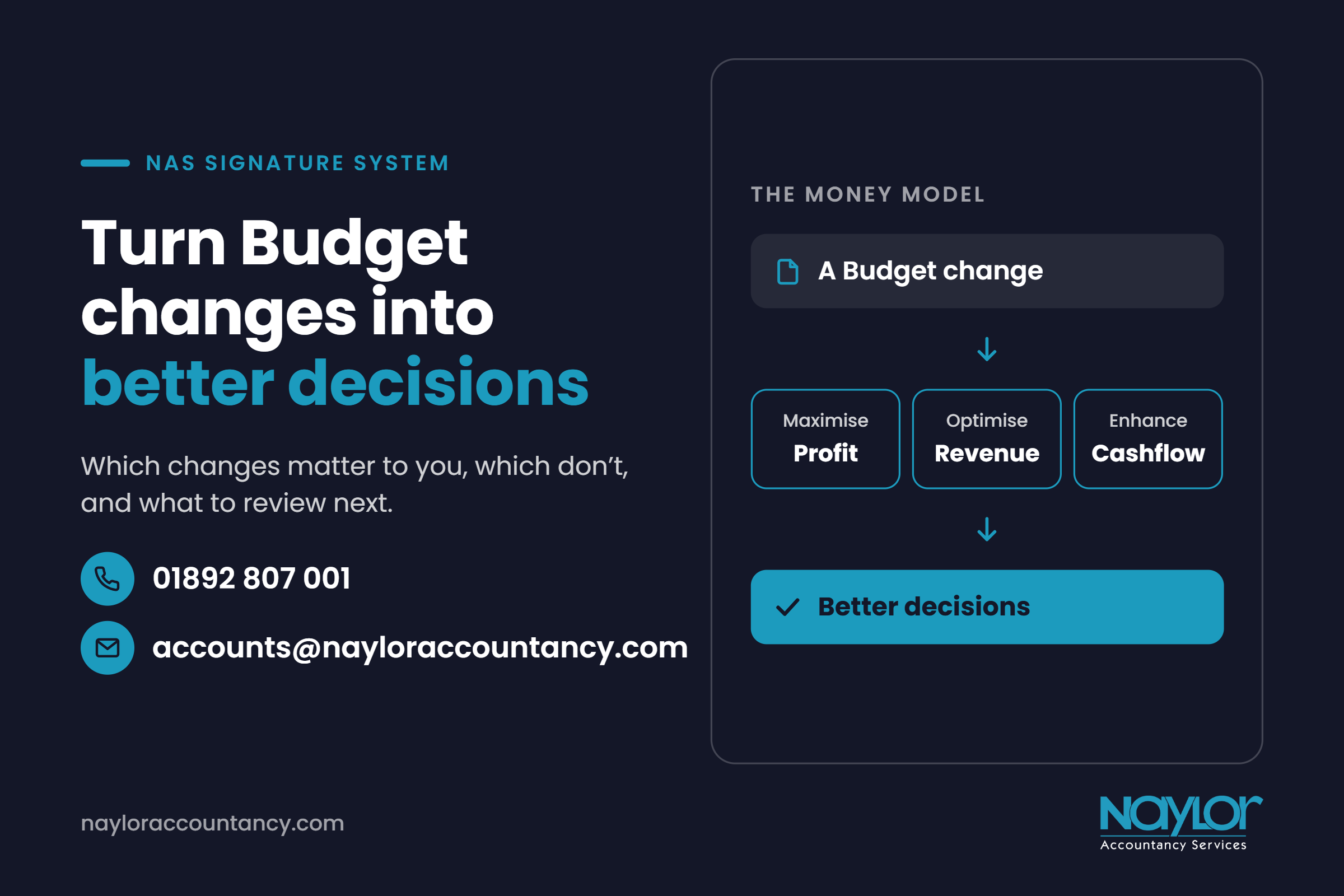
The Money Model within the NAS Signature System is not simply about knowing what tax is due. It is about understanding how changes affect profit, revenue, and cashflow, and using that information to make better decisions.
A Budget announcement should not sit in isolation from the rest of your business.
It should feed into the numbers, the plan, and the decisions you are already making.
Naylor Accountancy Services can help you understand which Budget changes matter to you, which do not, and what should be reviewed next.
Through the NAS Signature System, we can also help you look beyond the immediate tax change and understand what it means for the wider Money, Business and Structure of your business.
Not sure which changes apply to you?
You don’t need to work through every Budget announcement on your own.
Book a planning session with your Naylor Accountancy Services. Bring the one or two changes from this article that feel most relevant, and we will look at what they mean for your payroll, cashflow, profit and plans, and what is worth reviewing first.
Through the NAS Signature System, we can also help you see what a tax change means for the wider Money, Business and Structure of your business.
Book your planning session:
Main office: 01892 807 001
Email: [email protected]