Announcements
7 Oct 2026
Planning
7 Oct 2026

Limited places available for The Growth & Profit VIP Day 2026. Reserve your spot today.


Could your business run without you for two weeks? This blog looks at five signs your business may still depend too heavily on you, including decisions waiting for you, knowledge living in people’s heads and time away creating a recovery period.

Author
Nikolai Naylor
29 Sep 2026
Could your business run without you for two weeks?
Not perfectly. Not without some contact.
But could normal work continue, decisions be made and customers or clients be supported without everything coming back to you?
If the honest answer is no, your business still depends too heavily on you. That is common in growing owner-managed businesses, but it becomes more limiting over time.
It can slow decisions, frustrate the team, affect customer experience, and make time away feel harder than it should.
This is exactly the kind of pressure the Structure Model within the NAS Signature System is designed to help business owners review and create a structure that allows a business to work without you. It looks at the rhythm, roles, and processes behind the business, so growth does not have to depend on one person carrying everything.
Here are five signs worth checking.
If normal decisions cannot move without your approval, the business may not have clear enough decision boundaries.
That does not mean handing over everything at once.
It means deciding which decisions genuinely need you, and which decisions should now sit with someone else.
If every small issue still comes back to you, the team may be checking rather than owning.
A business becomes fragile when key information depends on memory.
If one person being away causes confusion, delay, or rework, the process probably needs documenting or tightening.
For a service-based business, that might mean client preferences, delivery steps, review points, or handover notes sitting with one person.
For a product-based business, it might mean supplier details, stock processes, fulfilment steps, platform knowledge, or returns handling depending too heavily on individual memory.
Either way, the risk is the same: the business works while the right person is available but struggles when they are not.
Different styles are normal?
Inconsistent delivery is normal?
When the same work is completed in different ways, quality, customer experience, and efficiency can all suffer.
For service-based businesses, this may show up with inconsistent client communication, different delivery standards, missed handovers, or too much senior review.
For product-based businesses, it may show up with inconsistent fulfilment, stock handling, customer updates, return processes, or aftercare.
This is not only an operational issue. It can affect profit, capacity, and trust. 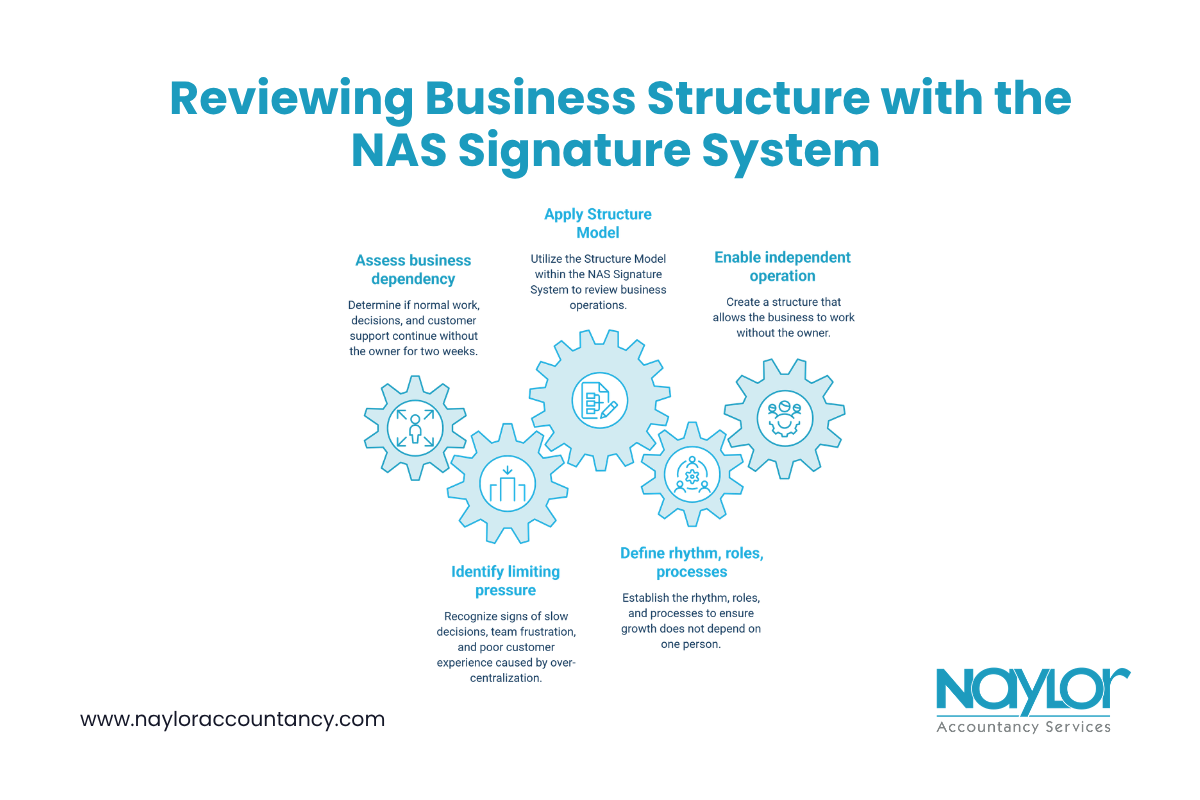
Good people may still check everything with you, the business owner, if roles and responsibilities are unclear.
That can make you feel needed and important, but it also limits the team’s ability to lead, make decisions, and improve.
Over time, it creates a loop.
The team waits because they are unsure, and they have always asked you.
You answer because it feels quicker.
The business keeps relying on you because that pattern has become normal.
The NAS Signature System helps identify where that pattern is coming from, especially where ownership, accountability, or decision paths are not clear enough.
If a few days off creates a queue of issues, messages and decisions, the business does not have the rhythm it needs.
Time away should not always create a recovery project when you return.
Regular check-ins, clear handovers, and better review points can reduce that pressure. They help the business keep moving without relying on last-minute chasing, inbox memory or owner intervention.
This is where owner dependency often becomes most visible.
You may be able to take time away physically, but if the business still waits for you mentally, the structure needs reviewing.
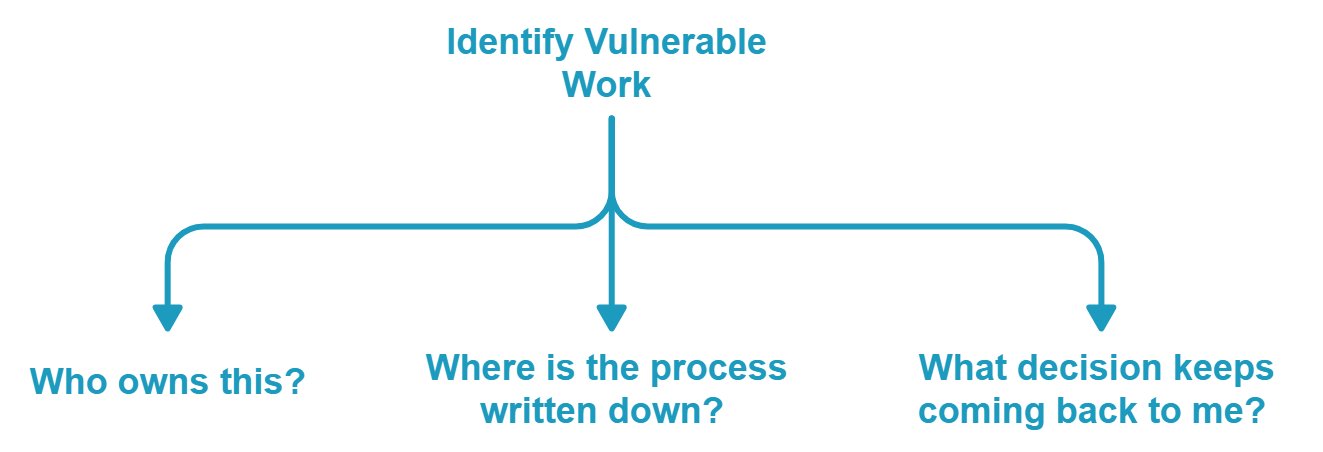
Start with the work that breaks when someone is away.
That is often the clearest sign of where the business needs better structure.
Then ask three questions:
Who owns this?
Where is the process written down?
What decision keeps coming back to me?
Those questions sit closely with the Structure Model within the NAS Signature System: Create Rhythm of Business, Design Org Chart and Streamline SOPs.
You do not need to fix every process at once. That would be a massive task. But you do need to know where the business is still too dependent on one person. You need to start to plan to create the business you want, one you can sell or pass on easily.
Naylor Accountancy Services can help owner-managed businesses, like yours, look at structure, process and financial visibility together, so growth does not have to depend on you carrying everything.
If you want to understand how the NAS Signature System could help you review owner dependency in your business, ask our team for the NAS Signature System brochure or contact Naylor Accountancy Services:
Email: [email protected]
Phone: 01892 807 001
Was this article helpful?
Your feedback helps us to improve our blog


Let's talk!